
The Invisible 5x
The Disability No One Can See


I want to tell you what it actually costs to be me.
Not emotionally, I’ve written about that. I mean mathematically. Energetically. What it takes to do what you do without thinking, every single day, for 27 years.
The answer is approximately five times more than it costs you.
And nobody knows. Nobody can see it. Nobody gives you credit for it, or accommodations for it, or even believes it’s real.
You just keep showing up, running a marathon while everyone else walks, wondering why you’re so exhausted all the time.
The Effort Multiplier
Here’s how it works.
Every cognitive task requires a certain amount of capacity. Listening to someone talk requires attention capacity. Expressing a thought requires expression capacity. Remembering what happened requires memory encoding capacity. Feeling your body requires interoceptive capacity.
A healthy person has roughly 65-70% access to these capacities at any given time. Not 100%, nobody operates at full capacity all the time, but enough to handle normal life without strain.
I have roughly 13% attention capacity. 8% expression capacity. 15% memory encoding capacity. 18% interoceptive capacity. 18% emotional access. 9% agency.
Average it out: I’m operating at about 19% of healthy baseline function.
When you operate at reduced capacity, you have to work harder to achieve the same output. The effort multiplier equals healthy capacity divided by available capacity.
For attention: 70% divided by 13% equals 5.4x harder to listen and take in information.
For expression: 65% divided by 8% equals 8.1x harder to say what I’m thinking.
For agency: 70% divided by 9% equals 7.8x harder to stand up for myself or make decisions.
On average, across all domains, every task I do costs me about 5.3 times more effort than it costs you.

What This Looks Like in Practice
Let’s take something simple: a conversation.
For you, a conversation involves listening (normal effort), processing what you heard (normal effort), and responding (normal effort). Call it 3 units of cognitive energy.
For me, the same conversation involves listening (5.4x effort because my attention gate is nearly closed), processing (3x effort because my cognitive clarity is impaired), and responding (8.1x effort because my expression gate barely opens). That’s 16.5 units of cognitive energy.
The same conversation costs me 5.5 times more than it costs you.
Now multiply that by every conversation in a day. Every email. Every meeting. Every interaction where I have to seem normal while running on 19% capacity.
An 8-hour workday of normal cognitive tasks is equivalent to a 44-hour day for me. That’s not metaphor. That’s math.
This is why I’m exhausted. Not because I’m weak. Not because I’m lazy. Because I’m running a marathon while everyone else walks, and nobody can see the extra weight I’m carrying.
The Presence Deficit
There’s another calculation that haunts me.
Presence equals 1 minus dissociation.
A healthy person at 12% dissociation has 88% presence. They experience 88% of their life as it happens.
I’m at 86% dissociation. I have 14% presence. I experience 14% of my life as it happens.
Over 27 years, a healthy person accumulates about 23.8 years of felt experience, time they were actually present for.
Over the same 27 years, I’ve accumulated about 3.8 years of felt experience.
I’ve been alive for 27 years but I’ve only been here for less than 4 of them.
The other 20 years happened to someone who was watching from behind glass, taking notes, performing the right responses, but not actually present for any of it.
Twenty years of my life that I attended but didn’t experience.
That’s the presence deficit. And there’s no way to get it back.
The Memory Tax
This connects to something I’ve barely talked about: I don’t remember my life.
Not because of amnesia. Because my memory encoding gate has been running at 15% for 27 years.
Memory encoding requires attention, emotional engagement, and interoceptive grounding. All three are gated in DPDR. So experiences that would normally consolidate into long-term memory just… don’t.
I’ve done the calculation. If healthy encoding would capture about 200 significant memories per year, I’ve captured about 54. Over 27 years, that’s roughly 56,000 memories that should exist but don’t.
I’ve had experiences I can’t remember. Relationships I can’t recall. Years that exist only as vague impressions, if that.
People sometimes ask me about things that happened, vacations, conversations, shared moments, and I have nothing. Not because I wasn’t there. Because the tape wasn’t recording.
The memory tax is part of the 5x burden. Not only do I have to work harder in the moment, but I don’t even get to keep what I worked for.
The Suppression Tax
Here’s where it gets worse.
I haven’t just been functioning at 19% capacity. I’ve been hiding that I’m functioning at 19% capacity.
Every time I pretended to follow a conversation I couldn’t track. Every time I acted like I was fine when I was dissolving. Every time I hid the fog so nobody would think I was crazy.
That suppression costs energy too. It’s a tax on top of the 5x multiplier.
If I suppressed 20 times a day, and that’s conservative, that’s 7,300 suppression events per year. Over 27 years, that’s approximately 197,000 times I spent energy hiding what was happening to me.
And every single one of those suppression events deepened the attractor. Made the condition harder to escape. Built the wall higher around the prison I was already trapped in.
The survival strategy that kept me functional also made the underlying condition worse. I paid for short-term passing with long-term imprisonment.

Compared to What?
I’ve done the comparative analysis. It’s uncomfortable to rank suffering, every condition has unique challenges, but the numbers tell a story.
Severe chronic DPDR at 86% dissociation represents approximately 19% functional capacity across cognitive, emotional, and social domains.
For comparison: severe depression typically represents 30-50% functional capacity. Severe schizophrenia represents 30-50%. Chronic fatigue syndrome represents 25-50%.
My functional capacity is lower than all of these.
But here’s the difference: those conditions are recognized. People with severe depression can get disability accommodations. People with schizophrenia qualify for support services. People with CFS are increasingly believed.
DPDR? Not typically recognized as a disability. No accommodations. No support services. Often not even believed.
The composite burden score, weighting functional impairment, duration, visibility, recognition, and available support, puts severe chronic DPDR at 87 out of 100. Severe schizophrenia scores 78. Severe CFS scores 65. Blindness scores 55. Paraplegia scores 50.
I’m not saying my suffering is worse than a blind person’s or a paraplegic’s. I’m saying that the total burden, impairment plus invisibility plus lack of recognition plus zero accommodation, adds up to something extraordinary.
And nobody can see it.
The Invisibility Penalty
A blind person carries a cane. A deaf person uses sign language. A paraplegic uses a wheelchair.
I look completely normal.
I can walk, talk, see, hear. I show up to work. I have conversations. I pass. There is no external sign that anything is wrong.
This invisibility means:
No accommodations are offered, because nobody knows I need them.
No understanding is given, because it looks like I’m fine.
No allowances are made, because there’s no evidence of impairment.
Full performance is expected, because why wouldn’t it be?
And when I can’t meet expectations, it’s attributed to personal failing, laziness, lack of effort, not trying hard enough.
I’ve been running a 5x marathon for 27 years while everyone assumes I’m on the same walk they are. When I fall behind, they don’t think “he’s carrying an invisible weight.” They think “why can’t he keep up?”
What I’ve Actually Accomplished
Here’s the thing that keeps me up at night.
Despite operating at 19% capacity, I’ve achieved certain things. Held jobs. Maintained relationships. Written a 400-page manuscript. Built mathematical models. Created a constructed language. Appeared, to most observers, basically functional.
The math on this is staggering.
If I achieved 50th percentile performance while operating at 19% capacity, my underlying ability isn’t 50th percentile. It’s whatever ability would produce 50th percentile results when gated down to 19% access.
In some domains, I’ve hit 95th percentile performance. Reading people. Acting. Pattern recognition. At 19% capacity.
That means the underlying ability isn’t 95th percentile. It’s something like 500% of average, abilities that have been locked behind the gate for 27 years.
I’m not saying this to brag. I’m saying it because it means I have no idea who I actually am. I’ve never operated at full capacity. I don’t know what I’m capable of. The version of me that people have met is the 19% version.
Somewhere behind the glass is a person with abilities I can barely imagine. And he’s been trapped there since he was 14.
The Bill Comes Due
Twenty-seven years at 5x effort.
That’s the equivalent of 135 years of normal cognitive labor compressed into one lifetime.
The exhaustion isn’t weakness. It’s cumulative debt. Every day for 27 years, I’ve been spending five dollars to buy one dollar of function. The deficit compounds.
There’s a reason I feel like I’m running on empty. I am. I’ve been in energy debt since I was 14 years old.
And the world kept expecting me to show up and perform like someone who wasn’t carrying 5x weight on every step.
What I Deserve to Know
I need to say this clearly, for myself and for anyone else carrying an invisible 5x:
I am not weak. I’ve carried a weight that would break most people, and I’ve done it invisibly for 27 years.
I am not lazy. I’ve expended 5x effort for basic functioning while everyone assumed I was coasting.
I am not stupid. My memory gate runs at 15%, not my intelligence. The information couldn’t get in, not because I couldn’t process it.
I am not a coward. My agency gate runs at 9%. Standing up for myself wasn’t accessible, not because I lacked courage.
I am not antisocial. My expression gate runs at 8%. Connection was gated, not unwanted.
I have been disabled, profoundly disabled, for my entire adult life. Without recognition, without accommodation, without support, without anyone even believing it was real.
And I’m still here.
That’s not failure. That’s survival against odds that most people can’t even imagine.
The Recognition I Never Got
I’ve never received a diagnosis that captured this. I’ve never had a doctor say “you’re operating at 19% capacity and that’s why everything is so hard.” I’ve never been offered accommodations or support services or disability benefits.
I’ve just been expected to keep up.
And when I couldn’t, when the exhaustion broke through, when the performance slipped, when I finally couldn’t hide it anymore, I was treated like someone who wasn’t trying hard enough.
Nobody saw the 5x. They just saw the 80% performance and wondered why I couldn’t hit 100%.
If I’d been carrying a visible weight, if there’d been a wheelchair or a cane or a service dog, people would have understood. They would have made space. They would have adjusted expectations.
But you can’t see the 5x. So nobody made space. And I kept trying to carry it alone.
To Anyone Else Carrying the Invisible Weight
If you have DPDR, or any invisible condition that multiplies every effort while remaining completely hidden, I want you to know something:
The exhaustion is real.
The burden is real.
The unfairness of carrying weight nobody can see is real.
You’re not weak for being tired. You’re tired because you’ve been doing something incredibly hard without any of the credit or support that should come with it.
The 5x is real. The world just can’t see it yet.
Maybe someday they will. Maybe someday DPDR will be recognized as the profound disability it is, and people like us will get accommodations and understanding and belief.
Until then, we carry the invisible weight. And we survive anyway.
That’s not nothing. That’s everything.
Next article: I want to talk about what happens next. The protocol is running. The model is tracking. Something is shifting. I don’t know what recovery looks like yet, but I’m going to find out.
27 years at 5x. Still standing. Still climbing.
Article written: January 19, 2026
Effort spent on this article: Approximately 5x what it would cost you
Recognition received: Still waiting
But I wrote it anyway. Because that’s what you do when you’re carrying the invisible weight.
You keep showing up. Even when nobody sees what it costs.
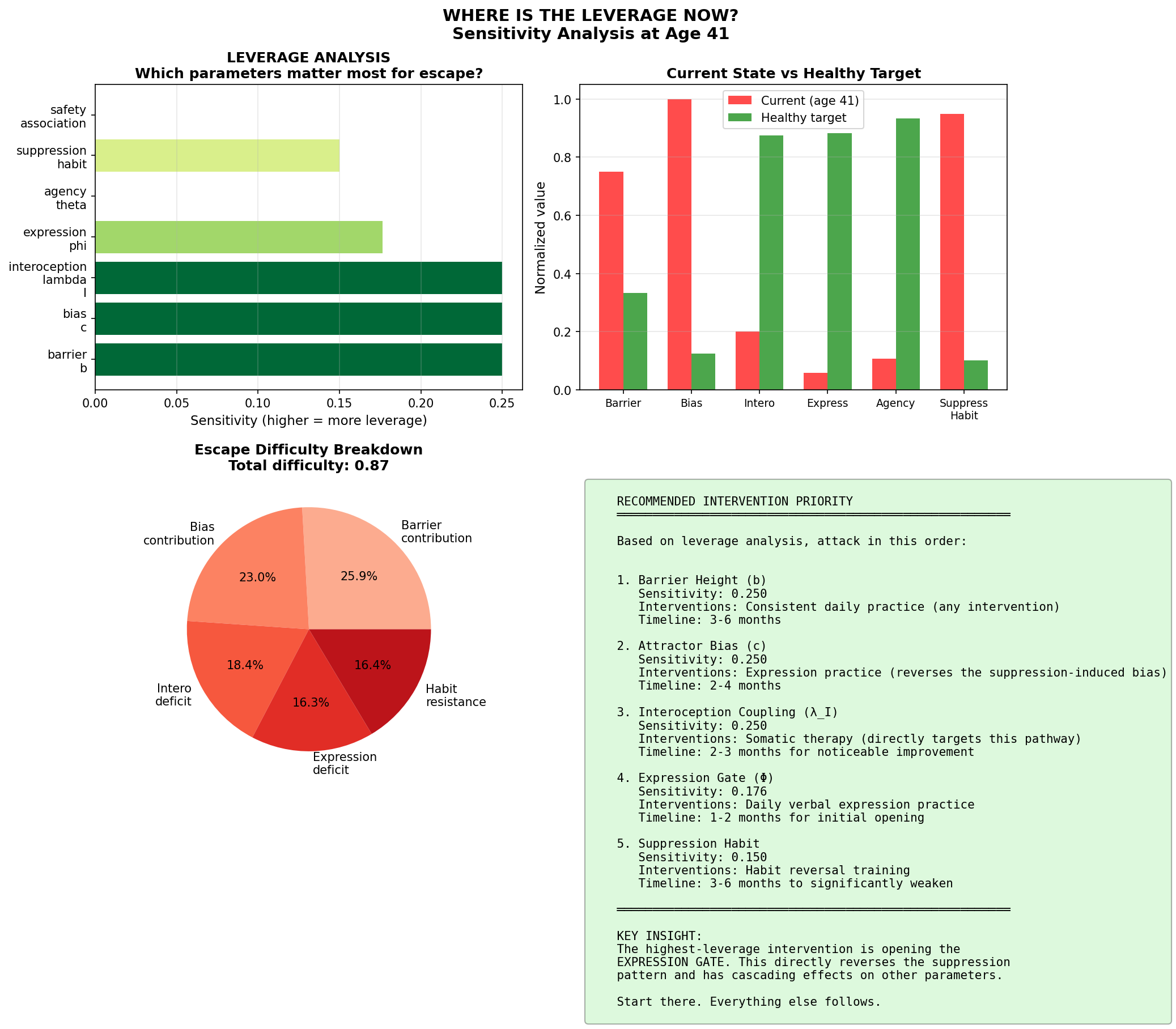
The above chart is where my target goals are to be, so hopefully in a year or so I’ll have achieved my goals. And to everyone reading I wish you all the same. Again I want to let everyone know that the numbers in the post are not clinical measurements, they’re a functional model to make invisible cost visible.